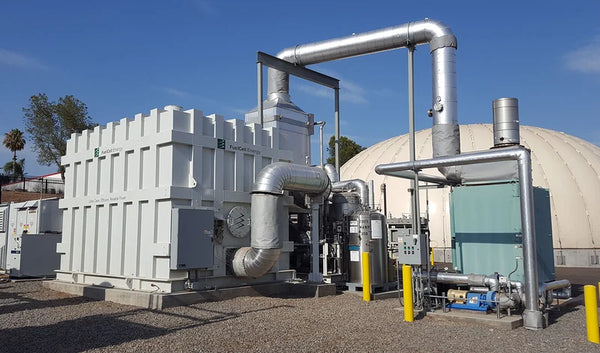
Research highlights the importance of pipeline networks for European H2 users.
The RFNBO Challenge
Batches of green hydrogen transported more than 500 km by diesel trucks would be unlikely to qualify as renewable fuel of non-biological origin (RFNBO) in the EU as lifecycle greenhouse gas emissions would exceed the limit set by European legislation, according to a new study.
Researchers from Bordeaux University and the French Geological Survey (BRGM) carried out a comparative lifecycle assessment of six land-based delivery pathways for green hydrogen to calculate the environmental impacts of each method.
This is particularly important in Europe because emissions from green hydrogen delivery to its final destination are included in lifecycle calculations that determine whether a batch of green molecules can qualify as RFNBO.
The EU Emissions Threshold
With certain industries mandated to use specific amounts of RFNBO in the EU by certain years, green hydrogen that does not meet the maximum cradle-to-gate emissions limit of 3.38 kg of CO₂-equivalent per kg of hydrogen is less likely to be purchased by European H2 consumers.
Six Delivery Scenarios Tested
The six "delivery scenarios" assessed all have the same start and end points and delivery distance for 15 tonnes of green hydrogen per day—H2 produced from 100% wind power using PEM electrolysers, transported 500 km by diesel truck or pipeline, with the delivered product being converted back to H2 at 200 bar pressure at its destination.
The six scenarios were:
Compressed hydrogen at 100 bar by pipeline
Compressed hydrogen at 700 bar by truck
Liquid hydrogen by truck
Ammonia by truck
Methanol by truck
Dibenzyltoluene (DBT, a type of liquid organic hydrogen carrier) by truck
Results: Only Two Methods Qualify
When taking into account green hydrogen production emissions of 1.10 kg CO₂e per kg H2, the researchers found that only two delivery methods could provide H2 below the EU RFNBO greenhouse gas threshold:
Compressed hydrogen by truck: 3.28 kg CO₂e per kg H2
Compressed hydrogen by pipeline: 2.36 kg CO₂e per kg H2
Ammonia was the next closest at 3.74 kg CO₂e per kg H2, followed by liquid hydrogen (4.49), DBT (5.42) and methanol (8.60).
Pipeline Superiority
The study—entitled "Beyond green hydrogen production: Ground transport within Europe, the hidden environmental impacts" and published in the International Journal of Hydrogen Energy—points out that compressed hydrogen by pipeline is in fact the greenest method of transportation for all distances up to 3,000 km. However, the paper does not take into account the costs of each transportation method.
The Cost Challenge
Pipelines might be the best solution from an emissions perspective, but they have high upfront costs. For instance, Germany is planning to build a more-than-9,000 km hydrogen pipeline network across the country at an expected investment cost of €18.9 billion, with doubts remaining that operators will be able to recoup upfront costs via transportation fees before 2055.
Real-World Geographic Constraints
The study makes clear that some potential usage sites—those far from green hydrogen projects or import terminals—could struggle to meet RFNBO requirements if relying on delivery by diesel truck.
For example, if manufacturers in Frankfurt were hoping to use imported green hydrogen arriving at the Port of Bremerhaven, the 504 km road distance would mean diesel-based deliveries would not count as RFNBO. Munich, an economic powerhouse, is more than 800 km away from the North Sea port.
Alternative Truck Solutions
Of course, using battery-electric or hydrogen fuel-cell trucks to transport compressed hydrogen would vastly reduce emissions. However, the study focused on current diesel truck capabilities.
While the global warming impact of green hydrogen production is low, "the impacts associated with its transformation, transport and storage along the supply chain can become, at best, non-negligible and, at worst, environmentally detrimental," the authors explain.
The Shipping Question
It is important to note that these figures do not take into account emissions from shipping green hydrogen and its derivatives to Europe, which would add considerably to their lifecycle greenhouse gas emissions.
This is significant because the EU still has a target of importing ten million tonnes of RFNBO into the bloc by 2030.
"Maritime shipping was deliberately excluded from the present scope, but it represents an important component of future European hydrogen logistics," the authors write. "Its potential impacts are multidimensional: while long-distance routes would increase absolute transport emissions, the large payload capacity of vessels compared to trucks could reduce emissions per unit of hydrogen delivered."
Strategic Implications
"Beyond environmental performance, international maritime trade also raises strategic questions regarding resource sovereignty and geopolitical dependencies, since Europe will likely rely on imports and may not have full control over its hydrogen supply," the researchers note.
Policy Implications
The findings have significant implications for European hydrogen strategy:
Infrastructure investment: The emissions advantage of pipelines strengthens the case for network buildout despite high costs.
Geographic planning: Industrial H2 users should locate near production sites or pipeline networks to ensure RFNBO compliance.
Import terminal placement: Port locations become critical for minimizing last-mile delivery distances.
Transportation mix: Battery-electric or fuel-cell trucks may be necessary for sites beyond pipeline reach.
Regulatory considerations: The 500 km threshold creates clear geographic limits for diesel truck delivery.
Future Research Needs
The researchers conclude: "Future research should address hydrogen ground-based transportation alongside maritime options in order to develop a comprehensive understanding of the sustainability of future European hydrogen supply chains."
This comprehensive view is essential as Europe builds out its hydrogen infrastructure and import capabilities. The study demonstrates that transportation method selection is not merely a logistics question but a critical determinant of whether hydrogen qualifies as truly renewable under EU law.
For European industrial users, the message is clear: proximity to pipeline infrastructure or production sites will be essential for accessing RFNBO-compliant hydrogen. Those relying on long-distance diesel truck delivery may find themselves unable to meet regulatory requirements, potentially forcing expensive relocations or infrastructure investments.