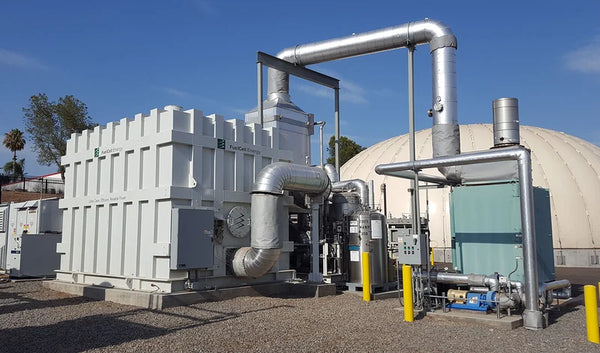
The project employs a technology capable of storing and releasing renewable energy even on gently sloping terrain.
Innovative Technology
A hillside “battery” located outside Plymouth in Devon has begun generating power using a first-of-its-kind underground hydropower system.
This breakthrough technology means that hydropower—one of the oldest forms of energy storage—can be used to store and release renewable energy on gentle slopes, rather than requiring steep dam walls or mountainous terrain.
The design enables hydropower principles to be applied as a form of long-duration energy storage across far more locations in the UK and globally than traditional hydropower dams. Such projects could also be constructed more quickly and at lower cost.
How It Works
Engineers at RheEnergise built the project to replicate the operating principles of traditional UK hydropower plants—which have supplied electricity to the grid for decades—by using surplus electricity to pump fluid uphill when power is abundant, and releasing it through turbines to generate electricity when supply is tight.
However, the company’s “high-density” hydropower system does not use water. Instead, it employs a mineral-rich fluid with more than 2.5 times the density of water, allowing the same amount of electricity to be generated on slopes less than half the height required by conventional systems.
Performance
RheEnergise CEO Stephen Crosher stated that the government-backed project has consistently achieved its 500-kilowatt generation target—sufficient, if operated continuously, to supply electricity to around 400 households for a year.
This serves as a vote of confidence in the technology, with the company now preparing to develop commercial-scale projects globally.
Expansion Plans
RheEnergise reports that it is in discussions with independent developers in the UK, Italy, Poland, Spain, and North America, with plans to build its first commercial-scale project within the next three years.
Larger projects are expected to follow in partnership with major utilities in the 2030s, as widespread renewable deployment increases demand for long-duration energy storage.
Government Support
The UK government has committed more than £69 million to the development of long-duration energy storage options and believes this technology can help manage the variability of wind and solar power by storing ultra-low-carbon electricity for longer periods—thereby reducing the overall cost of achieving net-zero targets.
This could reduce reliance on fossil fuels during periods of low renewable output and lower the frequency with which system operators must pay wind and solar generators to curtail production when generation risks overwhelming the grid.
Official Response
Science, Innovation, Research and Nuclear Secretary Patrick Vallance said: “As we transition to clean power, energy storage will play an increasingly important role. RheEnergise’s pioneering system has the potential to strengthen our future long-duration energy storage capability. As UK electricity demand grows and we move towards a clean power system that we can control, scaling up innovations like this will be essential.”
Key Advantages Over Conventional Hydropower
Terrain flexibility: Operates on gentle slopes rather than requiring steep mountains or dam walls.
Geographic accessibility: Deployable across a far wider range of locations in the UK and globally.
Construction speed: Potentially faster to build than traditional hydropower dams.
Cost efficiency: May be cheaper than large-scale conventional hydropower infrastructure.
Underground installation: Embedded systems minimize visual and environmental impact.
Technical Explanation
Conventional pumped-storage hydropower requires significant elevation differences to deliver meaningful power output, typically restricting deployment to mountainous regions with suitable reservoir geography.
RheEnergise’s innovation uses a mineral-rich fluid with 2.5 times the density of water. This enables equivalent energy storage capacity through:
Lower elevation differences: Slopes less than half the height of traditional systems.
Smaller infrastructure footprint: Reduced reservoir size due to higher fluid density.
More flexible siting: Operation on gentle hills rather than steep terrain.
The system operates on the same principles as traditional pumped storage: electricity charges the “battery” by pumping fluid uphill, and discharges it by releasing the fluid downhill through turbines.
Addressing Grid Challenges
As renewable capacity expands, the UK grid faces increasing challenges:
Intermittency management: Wind and solar output varies with weather conditions.
Curtailment costs: Grid operators must pay generators to halt production when supply exceeds demand.
Fossil fuel backup: Conventional plants currently fill gaps during low renewable output.
Peak demand: Energy storage helps meet evening demand peaks without fossil generation.
Long-duration storage technologies such as RheEnergise’s system address these challenges by storing surplus renewable electricity for hours or days and releasing it when needed.
Market Timing
The timeline for larger projects in the 2030s aligns with anticipated renewable deployment schedules. As wind and solar capacity expands, the value of long-duration energy storage increases proportionally.
Currently, power markets compensate storage facilities based on price differentials between charging and discharging periods. As renewable penetration rises, these spreads are expected to widen, improving the economics of storage.
Comparison With Other Storage Technologies
Lithium-ion batteries: Highly effective for short-duration storage (2–4 hours) but costly for longer durations.
Conventional pumped hydropower: A mature technology but geographically constrained and environmentally contentious.
Compressed air energy storage: Requires suitable underground geology such as salt caverns or depleted gas fields.
Hydrogen storage: Still under development and subject to efficiency losses during conversion.
RheEnergise’s technology occupies a middle ground: longer-duration storage than batteries, greater siting flexibility than traditional pumped hydropower, and simpler implementation than emerging hydrogen systems.
Environmental Considerations
Unlike conventional hydropower dams, which often flood valleys and displace communities, underground installations minimize surface disruption.
The environmental characteristics of the mineral-rich fluid require careful assessment, particularly regarding potential leakage impacts. However, enabling greater integration of renewables to displace fossil generation delivers clear climate benefits.
Commercial Viability Challenges
At 500 kilowatts, the Cornwood project’s capacity is negligible relative to commercial demand. Scaling to multi-megawatt systems will test whether the technology can retain its advantages at larger sizes.
Cost competitiveness relative to alternatives remains uncertain. While potentially cheaper than conventional pumped hydropower, mineral-rich fluids and specialized equipment may introduce higher costs than simple water-based systems.
The Road Ahead
Success in international markets over the next three years will determine the technology’s commercial viability. If demonstration projects meet performance and cost targets, RheEnergise could establish a foothold in the rapidly growing long-duration energy storage market.
For the UK, the technology represents a domestic innovation capable of supporting net-zero goals while creating manufacturing and installation jobs. The £69 million in government funding reflects recognition that long-duration storage is critical to a renewable-dominated power system.
The question remains whether high-density hydropower can compete against mature storage technologies and emerging alternatives in an increasingly competitive market.