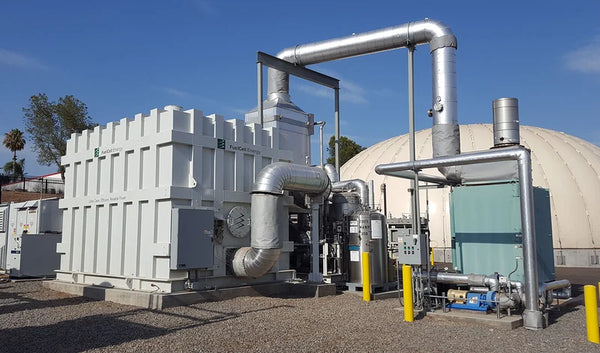
Wind and solar assets for the Neom green hydrogen and ammonia project are due to be completed by the middle of this year.
Project Progress Update
Construction on Saudi Arabia's flagship 2.2 GW Neom green hydrogen and ammonia project has reached 90% completion across all parts of the facility, Hydrogen Insight has learned.
"NEOM Green Hydrogen Company has reached 90% construction completion across all sites, including the green hydrogen production facility, wind turbine garden, solar farm, and transmission grid," said a spokesperson for the developer, which is co-owned by Air Products, ACWA Power, and the Saudi government's Neom investment vehicle.
"Construction continues at pace, with the integrated 4 GW solar and wind power generation assets on track for completion by mid-2026 and expected product availability in 2027."
Project Timeline and Milestones
The Neom project passed final investment decision in May 2023, becoming the first gigawatt-scale project to reach financial close and begin construction. This milestone positioned Saudi Arabia as a pioneer in large-scale green hydrogen development.
The first wind turbines were delivered in November 2023, demonstrating rapid progress following investment approval. By June 2025, "milestone equipment" including electrolysers, hydrogen storage tanks, and pipe racks had been received and installed.
Offtake Agreements
Air Products is already lined up to offtake 100% of the green ammonia produced at the Neom green hydrogen complex under a 30-year agreement. The company had originally planned to ship the ammonia to Europe and crack it back to green hydrogen for use in road transport.
However, last month Air Products revealed it was in talks with Yara for a marketing and distribution agreement. This would see Yara resell any volumes Air Products had not sold on a commission basis, providing additional market flexibility.
Scale and Significance
The integrated facility represents one of the world's largest green hydrogen projects. The 4 GW combined solar and wind power generation capacity will produce green hydrogen through electrolysis, which will then be converted to ammonia for easier transport and storage.
"As a global first mover in action, NGHC serves as the blueprint for large-scale, carbon-free hydrogen production, leading the global energy transition from the Kingdom of Saudi Arabia," the developer's spokesperson said.
Technical Components
The project encompasses multiple integrated sites:
Green hydrogen production facility: Houses electrolysers and conversion equipment.
Wind turbine garden: Provides renewable power generation capacity.
Solar farm: Complements wind power with photovoltaic generation.
Transmission grid: Connects renewable assets to production facility.
This integration ensures the facility operates entirely on renewable electricity, producing truly green hydrogen with zero carbon emissions from power generation.
Saudi Arabia's Green Hydrogen Ambitions
While the oil and gas sector continues to dominate Saudi Arabia's economy, the country appears to have doubled down on its early bet on green hydrogen with a second 4 GW green hydrogen project under development.
ACWA Power is developing this second megaproject, also apparently geared toward export to Europe. However, little information has come to light on this project, although ACWA Power has suggested it aims to start operations at the facility by 2030.
Strategic Positioning
Saudi Arabia's push into green hydrogen represents a strategic diversification from its traditional oil and gas economy. The country possesses significant advantages for green hydrogen production:
Abundant solar resources: High solar irradiance enables cost-effective photovoltaic generation.
Available land: Vast desert areas provide space for large-scale renewable installations.
Geographic position: Proximity to European and Asian markets reduces transport costs.
Existing energy infrastructure: Experience in large-scale energy projects and export logistics.
Market Implications
The Neom project's progress toward 2027 operations will provide crucial real-world data on large-scale green hydrogen production economics. Key questions include:
Production costs: Whether the facility achieves competitive hydrogen production costs.
Operational reliability: How integrated renewable-hydrogen systems perform at scale.
Market demand: Whether European transport sectors adopt green hydrogen as planned.
Export logistics: The viability of ammonia as a hydrogen carrier for long-distance shipping.
Global Competition
Saudi Arabia faces competition from other regions developing green hydrogen export capacity. Australia is planning massive projects targeting Asian markets, while Chile and Namibia aim to serve Europe. The Middle East's advantage lies in its established energy relationships and existing export infrastructure.
The Path to 2027
With construction 90% complete and renewable assets on track for mid-2026 completion, the Neom project appears positioned to meet its 2027 production target. This would mark a significant achievement: moving from investment decision to full operations in roughly four years.
For Saudi Arabia, successful operation of the Neom facility would validate its green hydrogen strategy and position it as a leader in the emerging hydrogen economy. For the global energy transition, it would demonstrate that gigawatt-scale green hydrogen production is technically and economically viable.
The next 18 months will be critical. Completing the remaining 10% of construction, commissioning all systems, and ramping up to full production will test whether ambitious timelines can translate to operational reality. The world is watching closely.