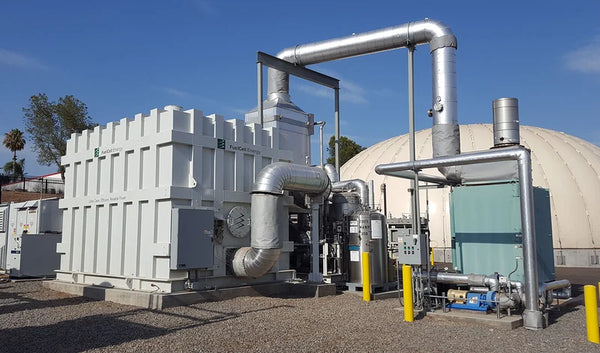
Equinor's decision to halt its blue hydrogen project in Groningen is not a story about engineering failure. It is a story about the absence of customers.
The Project That Couldn't Find Buyers
The H2M project secured EU Innovation Fund support and was positioned as a cornerstone of industrial decarbonization in the Netherlands. It had a defined technical pathway, a credible partner, and access to CO₂ storage infrastructure through Northern Lights.
What it did not secure was industrial offtake. Without long-term hydrogen purchase agreements, the project could not reach Final Investment Decision (FID).
Share of Dutch demand: 18–27%
Share of EU demand: 2–3%
Share of global use: ~0.2%
The Technical Architecture
Natural gas would have been produced offshore Norway and transported by pipeline to the Netherlands. In Groningen, the gas would be converted into hydrogen via reforming. The resulting CO₂ would be captured, compressed, conditioned, temporarily stored, shipped back to Norway, and injected into offshore geological formations under the Northern Lights project.
Northern Lights operates as a commercial CO₂ transport and storage system. It depends on emitters willing to pay for capture, shipping, and injection. Blue hydrogen projects were expected to serve as anchor customers. When one major project disappears, near-term demand for the storage network weakens.
The Ammonia Use Case
The central industrial application is ammonia — a feedstock for fertilizers, explosives, and chemicals. Global ammonia production is approximately 180 million tons annually.
2.7–3.2 tCO₂e per ton (GWP20 basis)
Most ammonia is produced from natural gas. Process emissions alone are about 2.4 tons of CO₂ per ton. Including upstream methane leakage (GWP20), total climate impact rises to 2.7–3.2 tCO₂e per ton.
Blue Ammonia Emissions
If blue hydrogen were used to produce ammonia in Rotterdam, lifecycle emissions would range from 0.6–1.8 tCO₂e per ton (GWP20).
Compared to grey ammonia, avoided emissions are approximately 0.9–2.5 tons per ton of ammonia — meaningful, but partial decarbonization.
Green Ammonia Alternative
An alternative pathway is producing green ammonia in high solar and wind regions such as Morocco and shipping it to Rotterdam. In this model, large-scale electrolysis produces hydrogen onsite. There is no methane feedstock and no carbon capture chain.
Electrolyzer capacity factor: 65%
Hydrogen cost: $3.5–5/kg
Delivered green ammonia: $800–1,000 per ton
Emissions: 0.03–0.11 tCO₂e per ton
Relative to grey ammonia, emissions approach near-zero.
Cost of Abatement Analysis
If grey ammonia in Rotterdam costs $600 per ton and blue ammonia costs $650, the premium is $50.
If blue ammonia avoids 1.5 tCO₂e per ton on average, the implied abatement cost is approximately $33 per ton of CO₂e.
If green ammonia costs $900 and avoids 2.8 tCO₂e, the abatement cost is roughly $107 per ton of CO₂e.
Blue is cheaper per ton avoided but does not reach near-zero emissions. Green is more expensive today, but approaches full decarbonization.
Carbon Pricing Changes the Game
EU ETS carbon prices are around €73 per ton today. EU budgetary guidance uses shadow carbon prices of:
€250 (mid-2030s)
€300 (2040 timeframe)
In a €200–300 carbon price environment, grey ammonia becomes structurally uncompetitive.
Grey hydrogen loses competitiveness to blue around €130 carbon pricing, and to imported green ammonia from Morocco around €150.
Under serious carbon pricing, the contest becomes blue versus imported green — not grey versus blue.
Why the Project Failed
Industrial buyers likely evaluated long-term carbon exposure, capital lock-in, and regulatory risk.
In a world where carbon prices may reach €200–300, partial decarbonization leaving 0.6–1.8 tCO₂e per ton may not be sufficient for 20-year offtake contracts.
Buyers must consider whether blue ammonia could become disadvantaged relative to near-zero alternatives before assets are fully depreciated.
Strategic Implications
The strategic objective for European industry is near-zero emissions.
Blue hydrogen reduces emissions but retains fossil carbon in the value chain. Green ammonia eliminates methane feedstock entirely and reduces emissions by over 95% relative to grey.
Importing green industrial intermediates — low-carbon ammonia, green iron, methanol — from regions with abundant low-cost renewable power can preserve competitiveness without exposing the economy to volatile energy pricing or underutilized infrastructure risk.
The Groningen project was not a zero-carbon solution. It was a partial one. Its cancellation may reflect a market signal: incremental reductions are no longer sufficient in a tightening carbon-budget world.