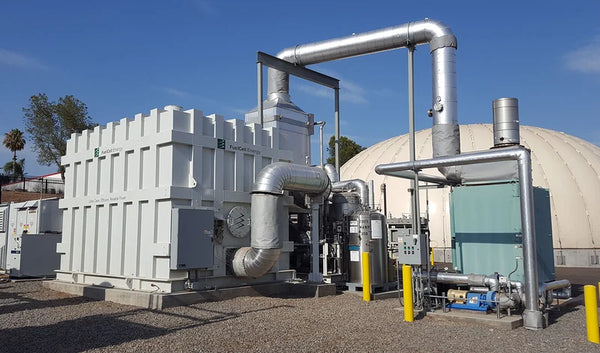
This is a shared challenge that affects every country: how do we progressively reduce our reliance on fossil fuels? The UK has been among the front-runners in renewables, and in 2025 it reached record highs in wind and solar generation. Yet the system often faces periods of renewable oversupply, forcing generators to curtail output at the grid operator’s request—while receiving compensation payments in return. Conversely, when weather conditions are unfavorable, wind and solar output can fall short. Keele University in Staffordshire believes it may have found a practical way forward.
Keele University’s Green Hydrogen Solution
Keele University’s on-campus “Low Carbon Energy Generation Park” can supply around 50% of the campus’s electricity demand and frequently produces surplus power. Rather than wasting this excess electricity, the university converts it into so-called “green hydrogen”—an approach already being deployed in practice by companies in Germany. Dr. Charlie Creissen, a Senior Lecturer in the School of Chemical and Physical Sciences, said the fuel has been used to power two Toyota hydrogen fuel cell vehicles. He noted: “It’s a very unique situation because we generate too much electricity from wind and solar, and this is actually a common national challenge—renewable generation sometimes exceeds what the national grid can accommodate.”
Hydrogen Production Process
Dr. Creissen elaborated: “When we have excess electricity, rather than switching equipment off, we use that power to produce green hydrogen and then use the fuel for vehicles. Because it is green hydrogen, the entire process is carbon-free, and the only thing emitted from the vehicle’s tailpipe is water.” He added: “Hydrogen is everywhere. It’s in the food we eat and the water we drink, and it is the most abundant element in the universe.”
The Only Emission: Water
Hydrogen’s abundance is precisely what has motivated Keele University to develop its own hydrogen production capability. Dr. Creissen explained: “Producing hydrogen is actually quite straightforward. We use electricity to electrolyze purified water, splitting it into oxygen and hydrogen. We then compress the hydrogen into liquid form for use in vehicles.” Because the process does not require any fossil fuels, the only emission when the vehicles are driven is water.
Green Hydrogen vs. Blue Hydrogen
However, this approach has not yet become mainstream in the UK. Most industrial hydrogen production still relies on fossil fuels, particularly natural gas, producing what is commonly referred to as “blue hydrogen.” Keele’s demonstration shows that green hydrogen can not only be produced successfully but also used in practice as a transport fuel.
Industry Perspective
Dr. Michaela Kendall of Adelan, a Birmingham-based hydrogen technology company, also supports the transition toward green hydrogen. She said: “I’ve been driving a hydrogen car for three years, and on a full tank it can do about 400 miles. The real issue isn’t the car—it’s where you can refuel.” She added: “There isn’t an energy crisis in this country; there’s an energy management crisis. Wind and solar farms are often paid to switch off because they produce too much power.”
The Cost Challenge
Even when generators are “not generating,” they can still receive substantial compensation. Data from the UK’s National Energy System Operator (NESO) indicates that constraint payments are approaching £2 billion, although the share attributable specifically to renewables has not been disclosed. NESO stated: “In the future, investment in transmission infrastructure and reforms to electricity market arrangements will be required to reduce costs for consumers over the longer term.”
Economic Advantage
Dr. Kendall believes Keele’s approach is highly representative: “Instead of switching equipment off, they chose to convert electricity that would otherwise be wasted into hydrogen.” She noted: “The price of hydrogen depends on how it is produced. If you use fossil fuels, the cost is naturally high. But if you use surplus renewable electricity, you can push costs down significantly—potentially close to zero.”
Future Pathways
Hydrogen vehicles have been available in the UK market for years, and the technology itself is not the limiting factor. The real challenge is the lack of refueling infrastructure. Looking ahead, as green hydrogen research continues to mature, the fuel could be increasingly applied to:
- Trucks
- Trains
- Other long-distance and high-energy-demand transport modes
along with the gradual build-out of a nationwide hydrogen refueling station network.
Key Advantages of Green Hydrogen
- Zero-carbon at point of use: tailpipe emissions are water vapor only
- An energy storage pathway: converts surplus renewable electricity into a storable fuel
- Abundant resource base: hydrogen is the most common element in the universe
- Long driving range: approximately 400 miles on a full tank
- Simple production route: produced via water electrolysis
- High economic potential: surplus renewables can materially reduce production costs
Current Challenges
- Severe shortage of hydrogen refueling stations
- Industrial hydrogen production remains dominated by fossil-fuel pathways
- Cost structures have not yet shifted decisively toward green hydrogen
- Renewables are still frequently curtailed, resulting in large-scale waste
The UK’s Energy Management Crisis
What Dr. Kendall describes as an “energy management crisis” highlights the grid’s structural inability to manage renewable variability effectively, including:
- Constraint (curtailment) compensation payments
- Renewable electricity that could be utilized but is instead wasted
- Insufficient transmission infrastructure
- Market mechanisms that do not adequately incentivize storage and flexible dispatch
Green hydrogen can play a pivotal role in providing energy storage and dispatchability.
Keele as a Proof-of-Concept
The project demonstrates several important principles:
- Produce locally, use locally
- Improve economics by utilizing surplus energy
- Technically mature and operationally stable
- Replicable and scalable as a broader model
Broader Application Scenarios
Beyond passenger vehicles, green hydrogen is also well-suited for:
- Long-haul freight trucks
- Non-electrified rail
- Industrial hydrogen substitution
- Large-scale grid balancing
International Context
Many countries are investing aggressively in hydrogen development:
- Germany: building hydrogen production and transmission networks
- Japan: positioning hydrogen as a cornerstone of energy security
- Australia: developing green hydrogen for export to Asia
- European Union: planning cross-border hydrogen corridors
If the UK does not accelerate, it risks falling behind.
The Technology Is Ready
Hydrogen vehicles have long been commercialized. The bottleneck is not technology, but policy, market design, and infrastructure. Keele’s work demonstrates that producing green hydrogen using surplus renewable electricity is viable both technically and economically. The remaining barriers are primarily rooted in regulation and system-level design.
Policy Implications
Unlocking the full potential of green hydrogen will require:
- Investment in the grid and transmission infrastructure
- Build-out of a hydrogen refueling network
- Electricity market reform
- Regulatory frameworks and safety standards
- A transition from blue hydrogen toward green hydrogen
Conclusion
So, can hydrogen replace gasoline and diesel? From a technical standpoint, the answer is yes. Keele University’s case shows that green hydrogen can power vehicles with zero carbon emissions at the tailpipe while simultaneously addressing renewable oversupply and system imbalance. The real question is not whether the technology works, but whether there is sufficient determination to drive reforms in policy, infrastructure, and market design. That will determine whether Keele’s demonstration becomes a blueprint for national energy strategy—or remains a standalone academic showcase.