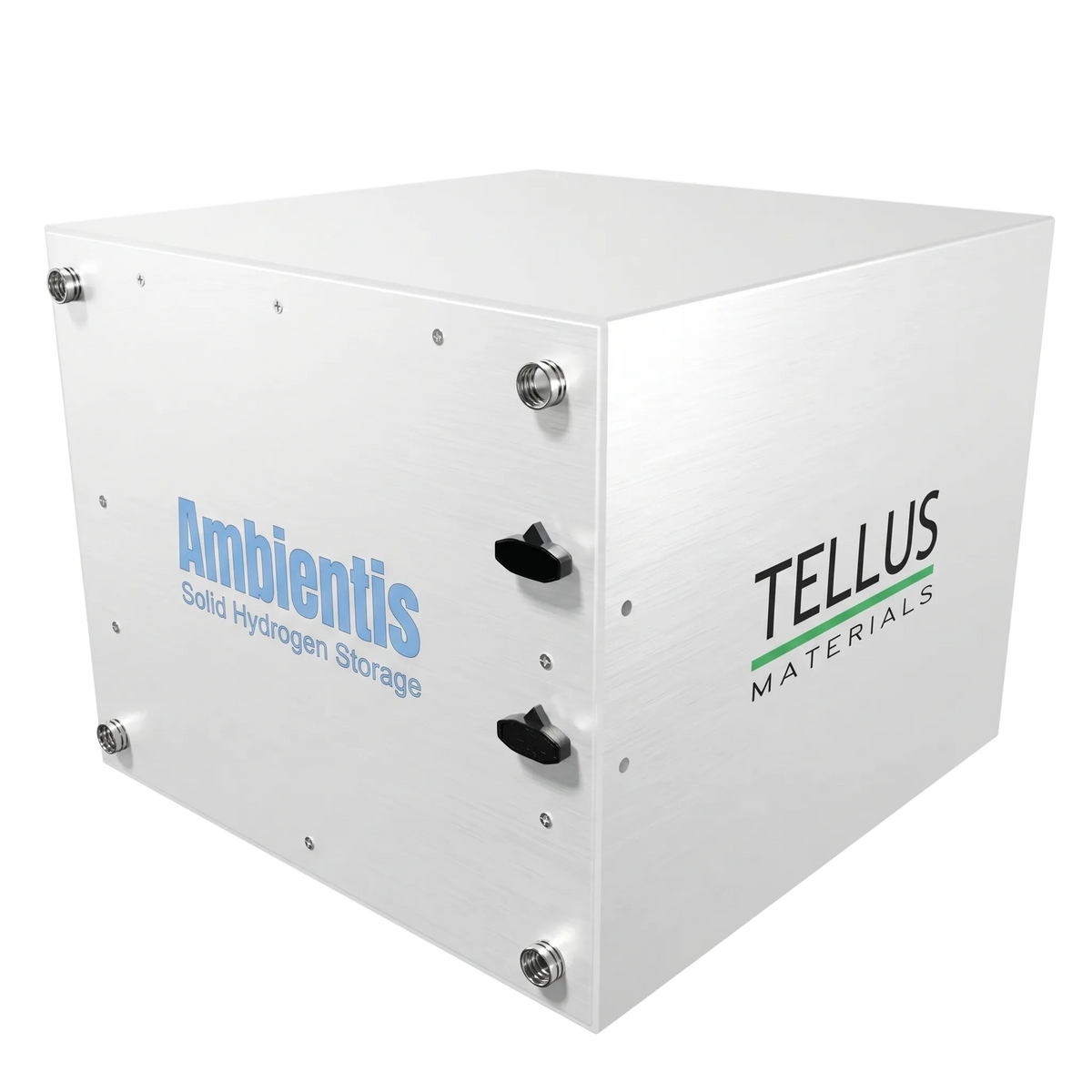
Ambientis Atmospheric Hydrogen Storage Cabinet:
No Compression, No High Pressure, Redefining Hydrogen Storage Safety
Through advanced solid-state metal hydride absorption technology, Ambientis S15 stably stores 15 kg of hydrogen under a safe, atmospheric pressure environment, providing up to 250 kWh of energy equivalent. This system completely breaks free from the legal constraints and occupational hazard risks brought by high-pressure cylinders. It is a core solution designed for microgrids, backup power, and green energy integration to help enterprises implement zero-carbon sustainable transformation.
Contact an ExpertHydrogen Storage Can Be Simpler
Core Advantages
Advantages of Atmospheric Hydrogen Storage
Traditional high-pressure hydrogen storage must operate under extreme pressures of 350 to 700 bar, which is accompanied by strict regulatory restrictions, leakage risks, and high compliance and maintenance costs.
Ambientis S15 utilizes solid-state metal hydride absorption technology. By locking hydrogen molecules through stable chemical bonding, it maintains a safe, atmospheric pressure state inside the cabinet. This not only fundamentally eliminates the risk of explosion at the source but also significantly optimizes a company's environmental risk indicators and occupational safety protection scores in ESG evaluations.
A Safer Way to Store Hydrogen
Avoiding extreme high pressure fundamentally reduces the risk of hydrogen leakage and accidents, making it easier for users to obtain safety permits.
Simplified System Design
With fewer equipment components, system integration becomes easier, the training threshold for operators is lowered, and the daily maintenance workload is significantly reduced.
Lower Overall Costs
Eliminating the costs of purchasing, powering, and maintaining compression equipment, and not requiring certified high-pressure personnel for operation, makes both the setup and long-term operational costs of the hydrogen storage system more competitive.
Deployment Flexibility
From industrial plants requiring large-capacity hydrogen storage to temporary power scenarios needing rapid mobile deployment, a single product series covers all needs.
Aligning with ESG and Sustainable Transformation
Perfectly integrated with green hydrogen systems, it not only helps industrial processes and energy storage sites accelerate the implementation of carbon reduction goals, but its high safety at atmospheric pressure also complies with the strict commitments to occupational health and safety in social responsibility.
Flexible Adaptation to Indoor Spaces
With external dimensions of only 1010 x 865 x 865 mm, its compact structure eliminates the need for strict spatial isolation requirements such as explosion-proof walls, significantly optimizing land use efficiency.
Operating Pressure Comparison
Say goodbye to the risk shackles of high-pressure cylinders,
and return hydrogen safety to atmospheric storage.
From Four Perspectives
Evaluation Dimensions
Intrinsic Safety and Occupational Hazard Protection
Operating in extremely high-pressure environments of 350 to 700 bar poses a high potential risk of explosion and large-scale leakage, significantly increasing the burden on corporate environmental safety supervision and occupational hazard protection.
Operating safely under atmospheric pressure, it fundamentally removes the dangers of high-pressure explosions and occupational hazards, fulfilling the commitment to zero major industrial accidents and perfectly complying with the ISO 45001 occupational health and safety standard.
Regulatory Compliance and Deployment Costs
Bound by strict special regulations for high-pressure vessels, site construction reviews are lengthy, and mandatory regular inspection costs remain high, significantly delaying the progress of corporate green energy deployment.
Exempt from high-pressure vessel regulations and complex explosion-proof reviews, this significantly reduces unnecessary compliance and maintenance costs, accelerating the overall site construction and deployment process.
Spatial Layout and Site Efficiency
The filling and transportation processes are cumbersome, requiring specialized operators and specific protective equipment. Additionally, strict explosion-proof isolation distance limits result in extremely low land space utilization.
Featuring a standard modular cabinet design, it supports safe deployment in indoor spaces such as factories or equipment rooms. It eliminates strict restrictions like explosion-proof walls, greatly enhancing land and construction space efficiency.
Carbon Reduction Benefits and Low-Carbon Integration
Energy storage density is significantly limited by the dead weight and working pressure of steel cylinders. The overall system is extremely bulky, making it difficult to further optimize transportation energy consumption and Scope 3 carbon footprint in the supply chain.
Utilizing solid-state adsorption for stable hydrogen release, combined with intelligent temperature control, it ensures a high-quality hydrogen supply. This comprehensively aligns with low-carbon manufacturing processes and zero-carbon emission source dispatch, optimizing corporate Scope 2 carbon reduction targets.
Product Specifications
Application Scenarios
From microgrid energy storage to hydrogen refueling buffers, enabling diverse energy scenarios

Microgrid Off-Grid Power Supply
Green energy storage, smooth output, and independent dispatching for renewable energy sites in remote locations or offshore islands, solving the dilemma of uneven energy distribution.

Hydrogen Refueling Station Buffer Storage
Buffering and storing hydrogen under near-ambient pressure to regulate peak and off-peak supply and demand at hydrogen refueling stations, enhancing overall operational stability.

Factory Process Carbon Reduction
Replacing partial fossil fuels with green hydrogen to assist in reducing process carbon emissions and advancing factory net-zero goals.

Research and Demonstration Sites
Providing research and academic institutions with a safe and controllable hydrogen storage validation platform to accelerate the real-world implementation of hydrogen technologies.
Learn More Detailed Specifications
Download Technical Documents
Leave your email to download the complete technical specifications and application cases.

Help & Support
Have questions?
Start here.
We have compiled the most frequently asked questions from our clients. If you can’t find the answer you’re looking for, please feel free to contact our team directly.
The system features a charge-discharge cycle life of over 15,000 cycles and maintains a high performance of over 85% even after long-term use. This physical stability makes it a more reliable long-term asset compared to traditional pressure vessels.
Yes. The S15 adopts a modular cabinet architecture, supporting multi-cabinet parallel expansion. During the planning phase, we will incorporate the overall piping, valve manifolds, and energy management system into the design based on the long-term capacity planning of your site, meeting the enterprise's long-term expansion goals on the path to carbon neutrality.
Significantly reduce energy costs: Because the operating pressure matches the electrolyzer's output pressure, there is no need for additional high-energy-consuming high-pressure compression equipment during charging, significantly saving electricity expenses.
Lower maintenance and labor expenses: The system's low-pressure design features a simpler structure and fewer parts than traditional high-pressure systems, reducing maintenance frequency and spare parts replacement costs. Its straightforward operation also lowers reliance on highly specialized technical personnel.
Extremely long asset lifespan: It features a charge-discharge cycle life of over 15,000 cycles with minimal performance degradation (maintaining over 85%). Compared to traditional storage equipment, it provides a much longer investment return period.
Traditional high-pressure steel cylinders rely on physical high-pressure compression of 350 to 700 bar, and safety heavily depends on the pressure resistance of the vessel. Solid-state hydrogen storage utilizes metal hydrides to lock in hydrogen through stable chemical bonds, allowing the cabinet to operate under near-ambient pressure. This brings fundamental safety advantages, eliminating the explosion risks of high-pressure vessels and the costs of complex regulatory inspections, offering greater sustainable value in terms of environmental and social responsibility.
The physical dimensions of this system are quite compact. Because it operates at near-ambient pressure, it is exempt from strict regulations such as the mandatory installation of explosion-proof walls required for high-pressure vessels, allowing for flexible deployment indoors and outdoors. During actual deployment, we will provide customized planning based on on-site ventilation conditions and the temperature-controlled water circuits (7 to 14°C for charging and 60 to 65°C for discharging).
No, it does not. The Ambientis hydrogen storage system operates at a low pressure of 10 bar, completing the charging process without the need for additional compression equipment. This effectively reduces equipment investment, energy consumption, and maintenance costs while simplifying the overall system architecture.