Tellus Materials Energy Technology Perspective
By-Product Hydrogen Power: A Hydrogen Business Model Ready for Today
The commercial operation of South Korea's Ulsan hydrogen fuel cell power plant validates a critical principle: hydrogen energy does not need to wait for green hydrogen costs to fall before delivering commercial value. The recovery and utilization of industrial by-product hydrogen represents the most technically mature and financially viable pathway for hydrogen power generation available today. For Tellus Materials, the GAIA hydrogen power module is designed precisely for this kind of application — converting existing hydrogen resources into stable electricity, starting from the industrial site, and turning hydrogen energy into a practical reality.
By-Product Hydrogen: A Long-Underestimated Energy Resource
In industrial chemical production, hydrogen is often little more than a byproduct — something that comes out of the process alongside the intended products. The chlor-alkali process, which uses electrolysis to produce caustic soda and chlorine, generates significant volumes of hydrogen as a byproduct. So does the production of ethylene and propylene at petrochemical facilities. Historically, much of this hydrogen was simply burned off or vented.
As hydrogen energy applications have matured, however, this logic has begun to shift. Since the cost of by-product hydrogen is already absorbed into the production economics of the primary chemicals, there is no separate investment required to generate it. Using it to produce electricity is economically straightforward — and increasingly attractive.
The newly commissioned power plant in Ulsan, South Korea, is a concrete expression of this thinking. Rather than building a new hydrogen supply chain from scratch, it captures an already-existing industrial byproduct and converts it into electricity.
Ulsan Hydrogen Power Unit 1: 20MW Now Online
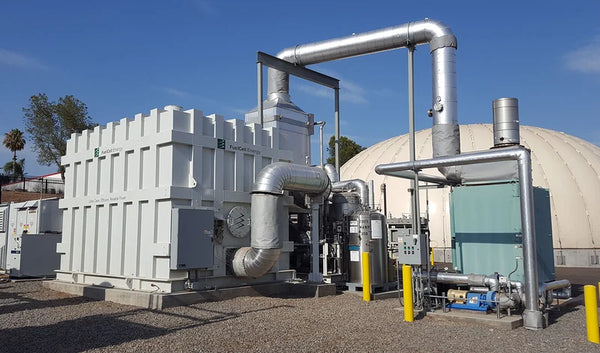
In April 2026, "Ulsan Hydrogen Power Unit 1" entered commercial operation, adding another hydrogen-fueled power facility to South Korea's east coast city of Ulsan. The plant has an installed capacity of 20MW and is located on the grounds of a Lotte Chemical facility in Ulsan, using by-product hydrogen from Lotte Chemical and SK Gas operations as its fuel source.
The facility is operated by Lotte SK Enerroot, a joint venture established in 2022 by Lotte Chemical, SK Gas, and Air Liquide Korea. This is not their first plant — "Ulsan Hydrogen Power Unit 2," also rated at 20MW, began commercial operation last June. With Unit 1 now online, the two plants together represent a combined capacity of 40MW.
According to the company's plan, Lotte SK Enerroot intends to complete construction of the remaining 40MW of capacity by the end of this year, bringing the total across all four facilities to 80MW. Project financing for all four plants was previously secured at approximately 272 billion Korean won (around USD 182.8 million).
Why Are Large-Scale Hydrogen Fuel Cell Power Plants So Rare?
Hydrogen fuel cell technology for power generation has long been technically mature, yet large-scale hydrogen power plants remain uncommon in global energy markets. The reason is straightforward: if hydrogen is produced from natural gas or renewable energy, it is more efficient and cost-effective to use those energy sources to generate electricity directly, rather than converting them to hydrogen first and then to power.
In other words, a hydrogen power plant is only competitive when its hydrogen supply is sufficiently cheap. This is precisely where by-product hydrogen holds an advantage — it requires no additional investment in hydrogen production, and instead recovers gas that would otherwise be wasted. Its cost structure is fundamentally different from hydrogen produced through conventional pathways.
South Korea is one of the few countries in the world that has made a serious commitment to large-scale hydrogen fuel cell power generation. The government has implemented a subsidy auction scheme that gives hydrogen-fueled electricity a competitive footing in the market, enabling commercial models like the Ulsan plants to take shape. Last September, construction began on what will be the world's largest hydrogen fuel cell power plant — a 108MW facility in the South Korean city of Gyeongju — which will use grey hydrogen produced on-site from natural gas to supply baseload power to the grid from 2028.
Waste Heat Recovery: The Added Value of Organic Rankine Cycle
Fuel cells generate waste heat as part of the electricity generation process, and if that heat simply dissipates, it represents an efficiency loss. Unit 1 in Ulsan has a notable additional plan: the integration of an Organic Rankine Cycle (ORC) system, which will convert waste heat from the fuel cell into additional electricity.
This system is currently being developed with state funding as part of the "Ulsan Mipo National Industrial Complex Energy Self-Sufficiency Infrastructure Construction and Operation Project." Once implemented, the overall energy efficiency of the plant will be further improved, maximizing the electricity output from every unit of hydrogen consumed.
This layered design philosophy — from by-product hydrogen to fuel cell generation to waste heat recovery — illustrates a complete industrial energy integration logic, and is a practical expression of the circular resource utilization principles that underpin modern energy system design.
The Broader Significance: By-Product Hydrogen Power Beyond South Korea
The commercial operation of the Ulsan plant represents a pragmatic direction within the broader hydrogen energy landscape. Compared to the green hydrogen electrolysis pathway, by-product hydrogen power generation does not require waiting for costs to fall — it is economically viable today, and the financial case is already proven.
For many industrially intensive countries and regions, this model carries strong reference value. Taiwan's petrochemical, semiconductor, and chemical industries similarly generate industrial hydrogen as a byproduct. If comparable recovery and utilization mechanisms could be established, it would not only reduce waste but also build real operational experience in hydrogen power generation during the sector's early commercial phase.
South Korea's path from policy framework to commercial power plant offers a development model worth studying. Hydrogen energy does not always have to be built from zero — starting from resources already embedded in industrial systems is often the fastest route to tangible results.