SolidHydrogen Storage Solutions: No High-Pressure Equipment Required
Tellus Materials introduces SolidHydrogen’s metal hydride technology, utilizing specialized alloys to store hydrogen at ambient pressure. This significantly reduces storage costs and safety risks, transforming hydrogen storage from a bottleneck into a catalyst for hydrogen energy adoption.
Consult a SpecialistHydrogen Storage Made Simpler
Why Choose Solid-State Hydrogen Storage?
Compared to high-pressure cylinders, liquid hydrogen, and other carriers, SolidHydrogen outperforms traditional solutions in safety, cost-efficiency, and practicality.
Current Industry Challenges
Conventional H2 logistics account for two-thirds of total costs.
Purification, compression, and storage represent two-thirds of the total hydrogen lifecycle cost. Only by reducing these expenses can hydrogen energy truly achieve industrial-scale adoption.
Expensive compression infrastructure.
Traditional methods require 350-700 bar compression, involving extreme CAPEX, maintenance costs, and high energy consumption.
High Safety Risks.
High-pressure storage carries explosion risks, necessitating stringent safety protocols and regulatory compliance, which drastically inflates construction and O&M costs.
Low Volumetric Hydrogen Density
Even at a high pressure of 700 bar, the hydrogen capacity per liter remains limited. At the same volume, solid-state hydrogen storage can accommodate significantly more hydrogen.
Hydrogen Storage Density Comparison
Technical Indicators
Metal Hydride: Molecular-Level Hydrogen Adsorption
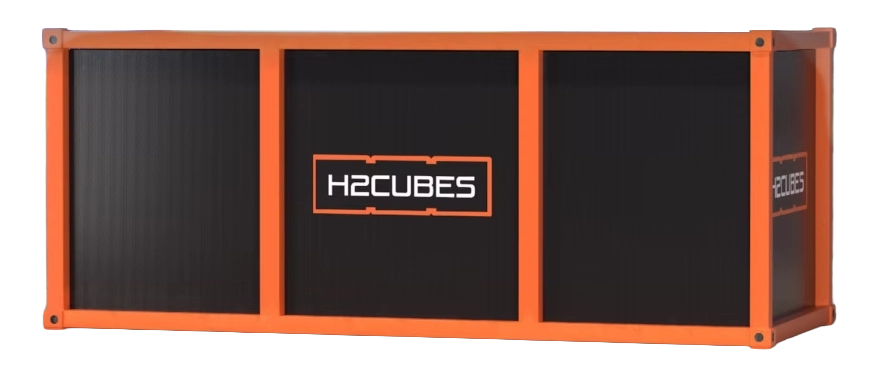
SolidHydrogen utilizes specialized metal alloys (hydrides) to adsorb hydrogen into the metal lattice at a molecular level under ambient temperature and pressure. The process is fully reversible—releasing hydrogen when heated and re-adsorbing when cooled—without the need for high-pressure equipment. This all-in-one system integrates purification, compression, and storage, condensed into a standard 20ft container.
This technology achieves the highest volumetric density among all current storage methods with zero explosion risk. The alloy can undergo over 10,000 cycles, equivalent to a 30-year service life.
Under ambient pressure, hydrogen molecules enter the metal alloy lattice and are stored via chemical bonding, eliminating the need for high-pressure compression.
Hydrogen storage density in metal hydride form exceeds that of 700 bar high-pressure gaseous storage, with zero explosion risk.
When hydrogen is required, heating the alloy to under 100°C enables a stable release of hydrogen gas, suitable for electrolyzers or fuel cell applications.
The alloy supports virtually unlimited adsorption and desorption cycles, with a service life exceeding 10,000 cycles (approx. 30 years). It is also 100% recyclable and reusable.
Product Specifications
Three Core Solutions
Covers storage, purification, and compression; available for individual purchase or as a fully integrated solution.
H2Cube Solid-State Hydrogen Storage Module
Scalable 20ft standard container units, each storing 1 ton of hydrogen. Modular design ideal for hydrogen refueling stations, industrial sites, and microgrids.
PuriCube: Hydrogen Purification Module
Custom-engineered purification system for SolidHydrogen technology. Outputs 99.999% Ultra-High Purity (UHP) hydrogen, suitable for semiconductor processes and fuel cells.
CompressCube Hydrogen Compression Module
Replaces traditional mechanical compression with thermal hydrides, compressing hydrogen from ambient pressure to 800 bar. It is 60% cheaper than mechanical compressors and has no moving parts, resulting in minimal maintenance requirements.
Help & Support
Have Questions? Start Here.
We have compiled the most frequently asked questions from our clients. If you cannot find the answer you need, please feel free to contact our team directly.
High-pressure cylinders require hydrogen to be compressed to 350–700 bar, which necessitates expensive compression equipment and carries a risk of explosion.
Solid-state hydrogen storage utilizes metal hydrides to adsorb hydrogen at ambient pressure, eliminating the need for high-pressure equipment. It offers higher safety and greater hydrogen storage density per liter. The primary difference is that solid-state storage significantly reduces overall storage costs and eliminates the risk of high-pressure explosions.
最適合的台灣場域包括:加氫站、半導體廠(需要高純度氫氣且希望降低外購成本)、工業廠區(有現場製氫需求)、以及離島或偏遠地區的氫能微電網。只要有氫氣儲存需求,H2Cube 都是值得評估的替代方案。
The metal alloy can be reused for over 10,000 charge-discharge cycles, with an equivalent service life of approximately 30 years. At the end of its life cycle, the alloy is 100% recyclable and reusable, producing no hazardous waste and requiring no rare raw materials, ensuring zero waste issues from start to finish.